The Elephant Room playbook for turning gift recipients into customers
You've got thousands of gift recipients and gifters sitting in Klaviyo. Here's the six-step playbook a Shopify Build Award winning, Klaviyo Elite Master agency runs to turn them into customers.

Every gift order hands you two people.
The gifter, who paid. They're already in your database and you market to them constantly.
And the gift recipient. They're holding something you made, but they chose none of it, paid for none of it, and may never have appeared in your marketing before.
Most brands focus on the first person and lose sight of the second.
For brands using Giftnote and Klaviyo, those recipients can become a distinct lifecycle audience rather than disappearing after delivery.
This is the gift recipient playbook Elephant Room runs to convert them.
The agency behind the playbook
Elephant Room is a Shopify Build Award winner and Klaviyo Elite Master Partner, with a seat on Klaviyo's Partner Advisory Council.
At DotDev 2026, Shopify's global partner event, Elephant Room won a Shopify Build Award for Merchant Impact, shared with Prosper Digital in the first-ever joint award Shopify has given and the first awarded to agencies from Asia-Pacific.
Shopify called it "a perfect picture of the ecosystem at its best: two partner-friends who share clients and build better together."
The winning work was Lioness. Elephant Room migrated them to Shopify and grew online revenue roughly 140x over five years. Prosper then lifted total sales 113% and conversion 74% inside six weeks.
Giftnote POV
Gifting breaks at the seam between commerce and CRM. The store captures the order. The CRM knows the buyer. But neither necessarily gives you a usable relationship with the person who received the product. Building a gift recipient lifecycle requires connecting those two sides.
Here's the playbook they recommend for turning gift recipients into customers.
Step 1. Keep recipients out of your welcome flow
This is the most common mistake, and it's worth fixing before anything else.
A standard welcome or post-purchase flow is built around the assumption that the person receiving the message is the person who engaged with or purchased from the brand.
A gift recipient didn't place the order.
They haven't necessarily subscribed to your marketing. They haven't necessarily bought from you before. And sending messaging that thanks them for an order they didn't place creates the wrong context from the beginning.
They're a third thing. Not a subscriber, not a customer. Someone mid-experience with your product, introduced by a person who knows them well enough to choose it for them.
That's an unusually warm introduction to a brand. It also decays fast, which is why the timing below matters more than the copy.
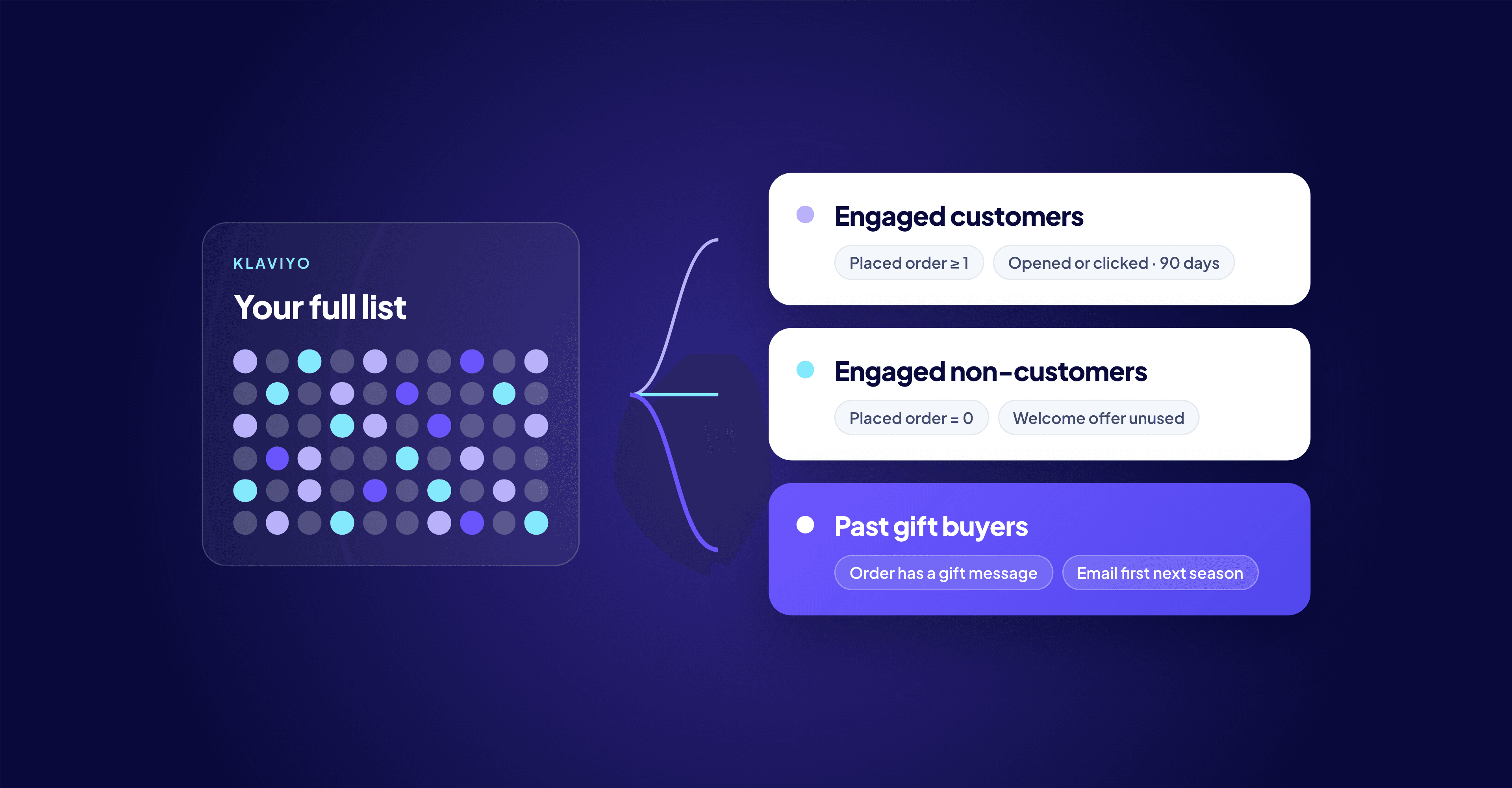
Step 2. Build these four audiences in Klaviyo
Before building a flow, separate the audiences:
- Gift recipients: profiles created from a gift delivery rather than a purchase. Your working audience for everything below.
- Gifters: customers whose orders were purchased for someone else. They have their own gifting behaviour, occasions and potential repeat-purchase cycle.
- Recipients who converted: anyone who arrived as a gift recipient and has since bought for themselves. Tag them. Their subsequent revenue and lifetime value help show what the gifting channel is worth.
- Repeat gifters: two or more gift orders. Your most valuable segment per contact.
The important part isn't just having these audiences.
It's being able to measure what each one does next.
That means separating recipient revenue from self-purchaser revenue, understanding which recipients become customers, and identifying gifters who return for the same or another gifting occasion.
Step 3. Send the message on delivery
The first recipient touchpoint shouldn't happen when the order is placed.
It should happen when the parcel arrives.
The content is the gifter's words, presented properly, with your brand around them rather than over them.
Think of it as the card that came with the present. It should read like one.
The delivery moment is also a natural opportunity for the recipient to engage with the brand and, where appropriate, opt in to future marketing.
The objective isn't to immediately turn the recipient into a sale.
It's to make the gifting experience feel complete and begin the recipient relationship in the right context.
Step 4. Three to five days later, give them context
By this point, they've had some time with the product.
Tell them what they have and how to get the most from it. How to use it, style it, prepare it, care for it or what makes it different.
No offer yet.
A discount at this stage puts a price on a relationship that has barely started.
Be useful first.
For a gift recipient who may have had no previous interaction with your business, this is an opportunity to provide the brand and product context that a normal customer might have picked up while browsing your website before purchasing.
Step 5. Two to three weeks later, make the first offer
Now an offer makes more sense. Two rules:
- Frame it as a first purchase, not a next one. Because that's what it is.
- Point at the product they already own, plus its natural companion. They know one thing about you. Build from it.
Don't simply reuse your standard welcome discount either.
A gift recipient has already experienced your product through a personal recommendation. That's a very different starting point from someone who entered their email through a popup or visited your website for the first time.
Your gift recipient flow should recognise that difference.
The final step shifts back to the gifter, because converting the recipient is only one side of the gifting opportunity.
Step 6. Close the loop: market the next occasion back to the gifter
This is the flow almost nobody thinks to build.
Someone who bought a birthday present last September has a birthday to buy for this September.
The occasion repeats. The relationship repeats. And the gifter is already a proven customer with a proven higher order value.
It's one of the highest-return gifting flows Elephant Room sees, and it's missing from almost every account they review.
Elephant Room's recommended 6-step gift recipient playbook:
- Keep gift recipients out of your standard welcome flow
- Build four audiences: gift recipients, gifters, converted recipients and repeat gifters
- At delivery: send the gift message and create the opportunity to opt in
- Day 3–5: provide product context without an offer
- Week 2–3: introduce a first-purchase offer based on the product received
- Month 12: remind the gifter about the gifting occasion
The same thinking, applied to a campaign
Elephant Room ran this logic in a different direction for Emma Lewisham, the B Corp certified New Zealand skincare brand.
In August 2026, they gave 20% back as store credit rather than taking 20% off upfront. The credit was issued automatically through Shopify Flow, Klaviyo carried the communications, and customers had 90 days to return and use it.
Different mechanic, same principle: use the incentive to drive the next relationship rather than discounting the one you already have.
Premier Catch shows the scale version. One corporate order reaches hundreds of clients. Each gets a branded message with their own name on it. Each can opt in to hear from the brand afterwards.
One order. Hundreds of introductions.
How Giftnote connects gift recipients with Klaviyo
There's one prerequisite for this entire gift recipient playbook:
The recipient needs to exist as an identifiable audience.
That's where standard ecommerce data can create a gap.
The store naturally captures the person who placed the order. But the person who ultimately opens the box is a different individual, and a shipping destination alone isn't a lifecycle audience you can segment and nurture.
Giftnote connects the gifting experience with the rest of the merchant's marketing stack.
With Giftnote and Klaviyo, gifting events can carry the information needed to distinguish the gifting journey and build relevant recipient experiences.
That allows ecommerce and retention teams to build audiences around:
Gift recipeints → Gifters → Recipients who become customers → Repeat gifters
Once those audiences are distinguishable, the lifecycle above becomes something brands can build, automate and measure.
And that measurement matters.
If gifting is invisible in your reporting, it's difficult to prove its value, and invisible channels don't get budget.
About Elephant Room
Elephant Room is a Shopify Build Award winner and a Klaviyo Elite Master partner with a seat on Klaviyo's Partner Advisory Council.
The agency works with ecommerce brands across retention, lifecycle marketing, performance marketing and campaign builds.
At DotDev 2026, Elephant Room and Prosper Digital received Shopify's Merchant Impact Build Award for their work with Lioness.
Founder Adam Sharon-Zipser describes the agency as having “the complete trifecta: an app on the App Store, an online store, and an agency.”
Disclosure: the app is Giftnote. Elephant Room is Giftnote's parent company.
Frequently asked questions
Should gift recipients go into my welcome flow?
No. A welcome flow thanks someone for an order they didn't place and offers a discount on a purchase they haven't made. Recipients need their own sequence, starting from the gift.
When should you email a gift recipient?
On delivery with the gifter's message. Three to five days later with context about the product. Two to three weeks later with a first-purchase offer. Sending the offer earlier prices a relationship that hasn't started.
Should you email the gifter or the recipient a year later?
The gifter. The occasion repeats for them, not for the recipient, and they're already a proven customer. It's the highest-return flow in gifting and it's almost never built.
How do you segment gift recipients in Klaviyo?
Build the segment on the gift event rather than on order data. With Giftnote, gift events pass the recipient's details into Klaviyo, so recipients can be separated from self-purchasers and reported on independently.
Can Shopify capture gift recipients without an app?
No. Shopify has no native gift message field and creates no contact record for a recipient unless they buy something themselves.
Why do gift recipients convert well?
They arrive holding your product with a personal recommendation attached, rather than clicking an ad. Around 74% are new to the brand, and about 1 in 10 goes on to buy for themselves.
What is a Shopify Build Award?
Shopify's own award for outstanding commerce builds, given once a year at DotDev, its global partner event. The 2026 winners came from seven countries.
What did Elephant Room win a Shopify Build Award for?
The Merchant Impact category at DotDev 2026, shared with Prosper Digital in the first-ever joint Build Award, for their work with Lioness.